LOCATION in the Virtual Sculpture Park (DAAP)
BIOGRAPHIE et COMMENTAIRES DE L'ARTISTE
Biographie / Biography
Robert J. Krawczyk, is an Assistant Professor in the College of Architecture at the Illinois Institute of Technology in Chicago focusing on digital craftsmanship. During his twenty-one years at IIT, he has developed and taught a series of CAD and digital design courses covering 2D and 3D CAD, image composition, animation, and form generation methods. In addition to teaching, he is an advisor in the PhD and Master’s programs on form generation and other related digital design methods. He also currently serves as Gallery Director for art @ IIT.
Robert is a graduate of the University of Illinois Chicago, College of Architecture; prior to teaching at IIT; he pioneered digital graphic applications in the architectural office of Murphy/Jahn in Chicago for eight years, covering the 1970’s, working on the architecture of Gene Summers and Helmut Jahn. After leaving Murphy/Jahn he started a computer consulting firm that has been slowly eclipsed by his work in digital art and architectural research.
His research into digital methods and artwork covering science, mathematics, architecture, and technology continues to be published and presented internationally in the form of prints, web pieces, sculptural, and architectural studies.
A highlight of his digital artwork was being selected for the SIGGRAPH 2001 and 2003 Art Gallery, including the 2001 SIGGRAPH International Traveling Art Show.
Artwork is displayed at: home.netcom.com/~bitart and student work, papers, and other projects are at: www.iit.edu/~krawczyk
Commentaire / Statement
Ring
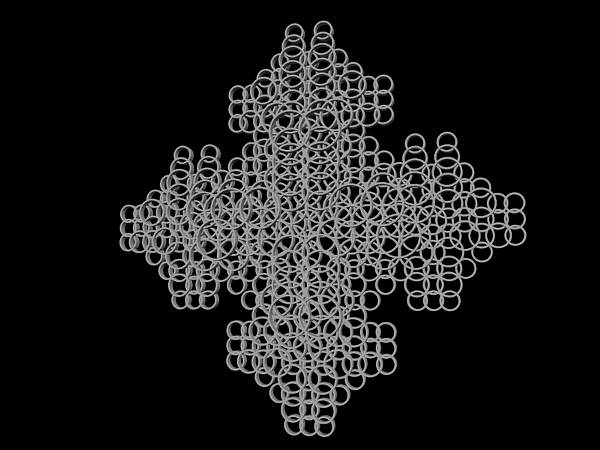
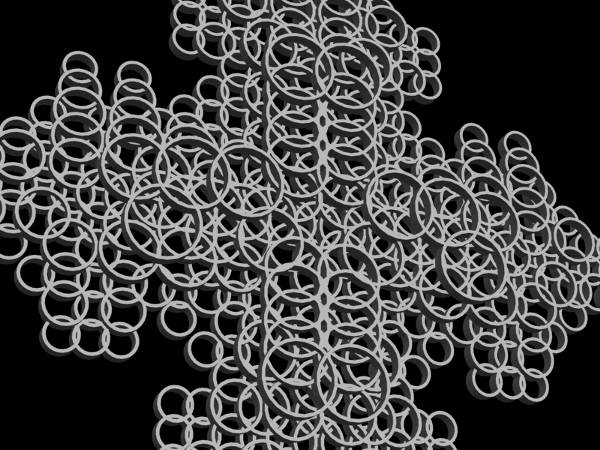
Cross 17140112. Ring Cross 17140112. The exploration of
cellular automata to generate two-dimensional ornamentation is extended
into three-dimensions. The pattern is based on generations of
survival, birth, and dead. As the pattern evolves, for each cell
that is occupied, its location and the number of times it is visited is
recorded. This measure of history is then used to determine the
rings three-dimensional location and its size. The underlying
two-dimensional patterns can be seen in the Metallic Lace section of:
http://home.netcomn.com/~bitart
This ornamentation can be grille to filter for light through or part of
a building elevation as a false front. It could even be used for
framing glass in a clear-story window or a section of overhanging
shading. The 2D version of these could be used to filter light if
the patterns were sand blasted in glass.